Behind the Screens: How Support Teams Coordinate with Payment Processors to Validate Tournament Bonuses in Real Time
Eden Friedrich · May 29, 2026
Behind the Screens: How Support Teams Coordinate with Payment Processors to Validate Tournament Bonuses in Real Time
Support teams in mobile tournament platforms maintain constant connections with payment processors to confirm bonus eligibility during active competitions, and this coordination relies on layered API integrations that exchange data within milliseconds of each player action. Data from industry reports indicates that platforms handling thousands of concurrent sessions in May 2026 processed bonus validations through automated triggers linked directly to processor gateways, while human agents stepped in only when flagged discrepancies exceeded preset thresholds. Observers note that these systems draw on transaction histories, account verification status, and tournament-specific rules to prevent unauthorized redemptions before funds reach player balances.
Core Coordination Protocols
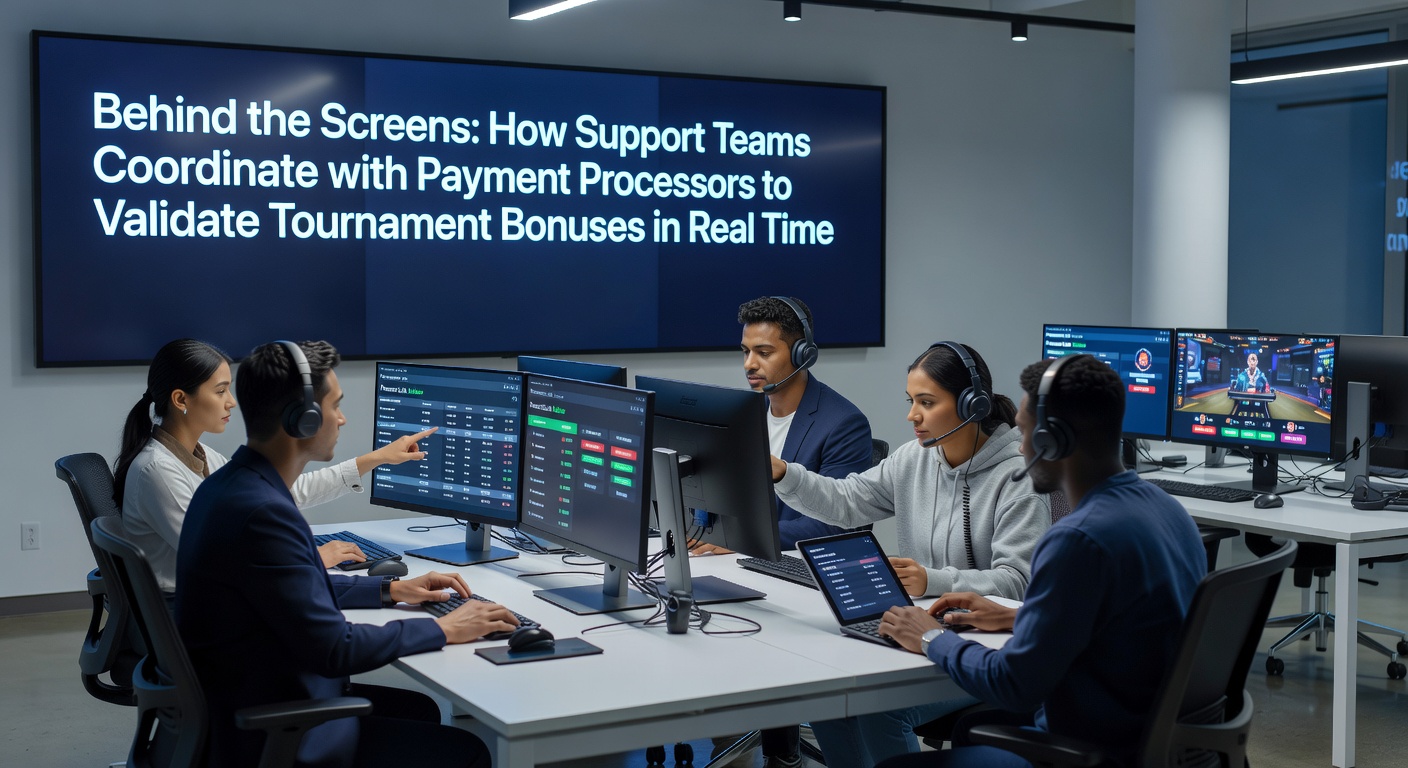
Teams operate from centralized dashboards that aggregate signals from both internal game servers and external processor feeds, allowing agents to review pending bonus awards in sequence rather than isolation. Payment processors supply endpoint responses that include authorization codes, risk scores, and compliance markers, which support staff cross-reference against live tournament logs to ensure requirements such as minimum play volume or deposit timing remain satisfied throughout the event window. Research from the Australian Gambling Research Centre shows that synchronized data streams reduce validation latency by integrating rule engines on the processor side with support ticketing systems on the platform side, creating a continuous feedback loop that updates eligibility flags without interrupting gameplay.
Technical Infrastructure Supporting Validation
Real-time checks begin when a player triggers a bonus claim or completes a qualifying action, at which point the platform initiates an encrypted query to the processor's validation service. The processor evaluates parameters including account age, prior bonus usage, and geographic restrictions before returning a binary approval or a detailed rejection reason that routes to the support queue. Experts at the North American Association of State and Provincial Lotteries have documented how these queries incorporate tokenization standards to protect sensitive financial details while still transmitting the metadata needed for tournament rule enforcement. And because tournaments often span multiple time zones, platforms schedule staggered processor maintenance windows to avoid gaps in coverage during peak competition hours in May 2026.
Handling Edge Cases and Escalations
When automated responses indicate potential mismatches, such as duplicate claims or velocity anomalies, support personnel receive contextual alerts that include player session timelines and processor-side hold statuses. Agents then initiate direct queries through secure channels to confirm whether a pending transaction aligns with tournament bonus terms, and resolution occurs through coordinated updates that both systems acknowledge before funds finalize. Figures from the Canadian Centre for Gaming Research reveal that escalation volumes remained stable across major platforms during the first quarter of 2026, suggesting that refined rule sets and preemptive flagging have kept most validations within automated bounds. Yet complex disputes involving cross-border accounts still require manual review loops that draw on regional regulatory guidelines to maintain consistency.

Regulatory Alignment and Reporting
Platforms align validation procedures with jurisdictional requirements by embedding compliance checkpoints into the same processor interfaces that handle bonus approvals. Support teams generate audit trails from these exchanges, which regulators access through standardized reporting portals to verify that bonus distribution follows published terms. The Malta Gaming Authority publishes periodic guidance on real-time monitoring obligations that many operators reference when configuring processor connections, ensuring documentation captures every validation decision at the moment it occurs. Data exchanges also support broader anti-money laundering protocols, as processors append additional risk indicators that teams review during high-value tournament periods.
Future Developments in Synchronization
Developments scheduled for rollout later in 2026 focus on expanding processor support for machine-learning models that predict bonus eligibility before a player even initiates a claim. These models would feed preliminary scores back to support dashboards, allowing agents to prioritize interventions on sessions most likely to encounter validation friction. Studies conducted by the University of Nevada, Reno's gaming research division indicate that earlier adoption of similar predictive layers has already shortened average resolution times for flagged transactions across tested platforms. Continued refinement of these tools depends on sustained cooperation between support operations and processor engineering teams to maintain data accuracy across evolving tournament formats.
Conclusion
Coordination between support teams and payment processors forms the operational backbone that keeps tournament bonus validation accurate and immediate, relying on integrated APIs, shared rule engines, and structured escalation paths. As platforms scale events throughout 2026, these connections continue to evolve through standardized reporting and incremental technical upgrades that preserve compliance without compromising speed. The result is a system where eligibility checks occur seamlessly within the flow of competition, supported by documented processes that regulators and operators alike can audit in real time.